
The digital environments we navigate daily are highly emotional spaces. We scroll through feeds that can shift our mood in seconds, evoking happiness, curiosity, or sudden frustration. Yet, behind the screen, complex media mechanics and platform algorithms are constantly analysing our feelings. Understanding how these emotional narratives influence us is the first step toward reclaiming our digital agency.
This was the core focus of Emotional Narratives & Media Influence, the third online workshop in the Spain edition of the HATE-LESS Train the Trainer series, which took place on 4 June 2026, from 17:00 to 18:30 CET.
Delivered by Evolutionary Archetypes Consulting SL, the interactive session brought together youth workers, trainers, and young people. The entire workshop was built directly upon Module 2 of the HATE-LESS Toolkit, a comprehensive guide designed to foster digital empathy and media literacy.
The Hummingbird Pause & Awareness of Social Media Algorithms
The workshop began with an interactive energiser called The Hummingbird Pause.
Participants first answered a reflective Mentimeter question to set a positive tone: “What social media topics make people feel happy, hopeful, or excited about their day?”
Using emojis and words to express their answers, the group transitioned into a deep reflection based on the ancient story of the hummingbird. In the tale, a forest is on fire, and while the other animals stand by, overwhelmed by the flames, a tiny hummingbird flies back and forth carrying drops of water. Instead of doing nothing or spreading fear, the hummingbird simply asks, “What can I do to help?”
In our digital lives, this translates to pausing before we post or comment, asking ourselves:
“What does my reaction feed?”
Beyond self-reflection, the session explored the structural side of online spaces, specifically, how algorithms recognise emotions. Participants examined how platform algorithms identify content with specific emotional tones based on user preferences. Over time, networks like YouTube recommend increasingly emotionally charged content to keep users engaged. Through a guided visualisation, the training group observed a young person’s emotional reaction to a social media post, practising how to guide them to pause before reacting.
Using live Mentimeter reflections, participants brainstormed what tools and techniques help a young person move from an automatic emotional reaction to responsible online action.
Practical Storytelling: The FEEL Video Practice
In the main segment of the workshop, participants put their reflections into practice through the FEEL Video Practice.
The activity started with a Mentimeter Emotion Poll. Learners analysed real-world scenarios where young people experience intense emotions online and voted on two key questions:
1) How would most young people react first?
2) What would be a healthy, constructive response?
Following this reflection, participants learned the FEEL framework for creating positive, responsible video messages:
- Feeling: Identifying the emotion invitation.
- Effect: Understanding the impact of the message.
- Expression: Choosing how to express the narrative safely.
- Light: Bringing constructive, empathetic perspectives to the surface.
Guided by this framework, participants collaborated to write scripts and record their own short participatory video clips, proving that empathy can actively disrupt digital hostility.
“When the algorithms reward outrage, compassion becomes a form of resistance.” – Lawrence Nault.
The Shared Message of Our Participatory Video
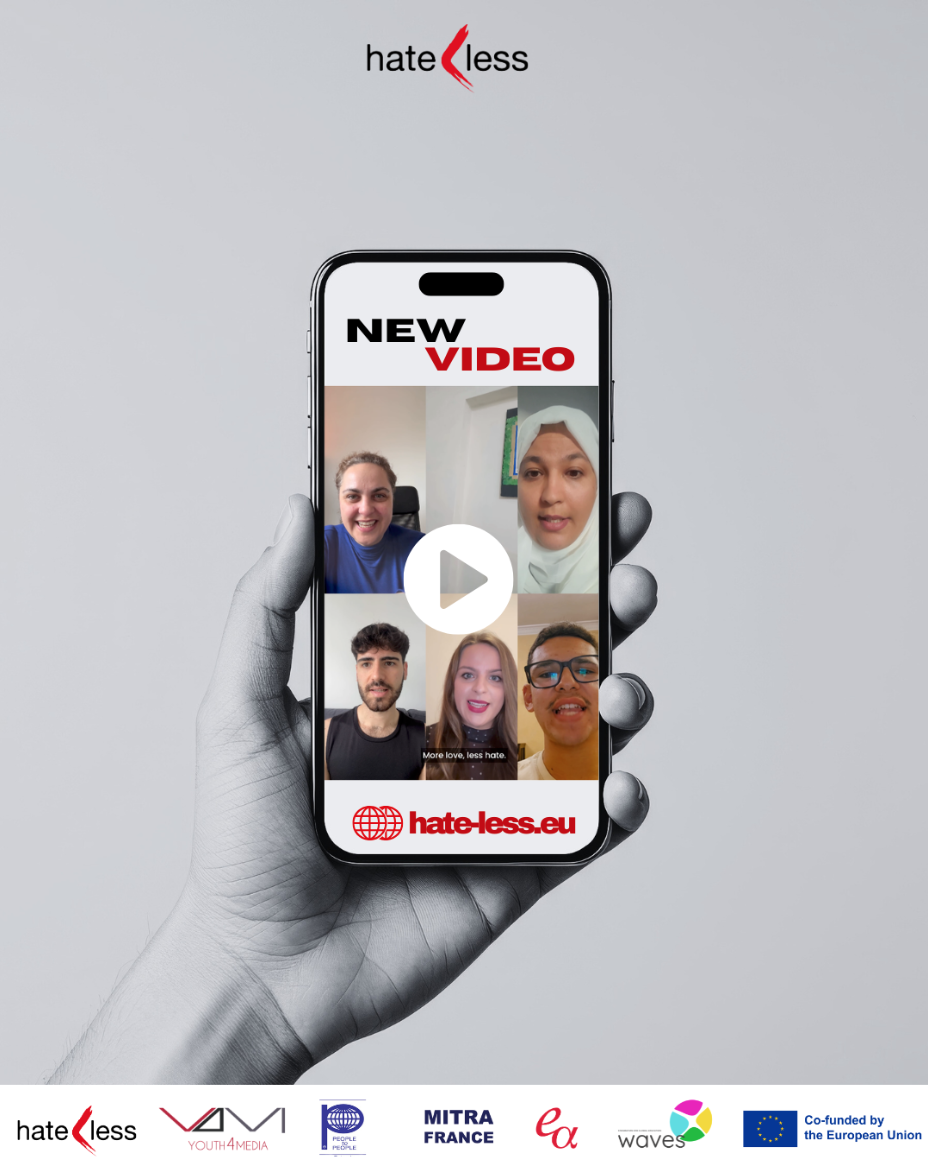
The individual video clips recorded by our trainers and youth workers during the session were woven together into a single, cohesive participatory video. The final script serves as a beautiful and necessary reminder for everyone navigating today’s attention economy:
“When I use social media, I see comments that are hurtful or unfair. Social media is a powerful, double-edged sword. It has completely democratised creativity and connection. Yet, it simultaneously functions as an aggressive attention economy that thrives on our deepest insecurities.
But when I stop and think about it, I remember that social media only shows part of the story – usually the best part, not the whole picture. I remember: I’m not here to win arguments. I’m here to stand for respect, for truth, for humanity.
So, instead of reacting to this post, we can choose to be empathetic.
‘More love, less hate’ begins when we start with self-kindness and share from a place of care.
Let’s keep it ‘HATE-LESS’. More love, less hate.”
🎬 Watch the final participatory video on YouTube:
https://youtube.com/shorts/mnTtlXF6maQ
Explore the HATE-LESS Resources: Download the official HATE-LESS Toolkit
https://hate-less.eu/wp-content/uploads/2026/03/Hateless-Toolkit.pdf
Funding Agency: JUGEND für Europa
Learn more about HATE-LESS: https://hate-less.eu